
Identify Who Owns Wayne County Property
A short chain of official property records answers the question. Wayne County qPublic gives the parcel and the tax-roll owner. The Clerk of Superior Court and GSCCCA hold the most recent recorded deed. PT-61 transfer data links recent buyers, sellers, and consideration. A Georgia business filing pins down an LLC's exact legal name. Each source does one job, so use them in combination.
- Enter the physical address in Wayne qPublic. If it does not match, identify the parcel by owner name, parcel ID, or legal information.
- Read the Owner field on the parcel card and copy the name, Parcel ID, Physical Address, and deed or sale reference exactly.
- Search the owner as grantee in the GSCCCA Real Estate Index, then inspect the newest plausible deed and legal description.
- If the grantee is an LLC, verify the entity name in Georgia eCorp. For a trust or estate, keep the trustee or fiduciary wording intact.
This method reveals the record owner, not whoever occupies the land. For a closer look at the roll's current name, see the Wayne County current owner record.
Wayne County Owner Fields
The Wayne County Tax Assessor/qPublic portal publishes the latest tax digest through its site. A full parcel card shows the Parcel ID, Owner, Owner address, Physical Address, class code, taxing district, acres, assessed value, and sale history. The two address fields play different roles. Physical Address is the land's situs. Owner address is where the assessor sends assessment mail.
The official sample makes the split plain, because its physical address and owner mailing address are different places. That is normal. It does not tell you where the owner lives. Still, the qPublic result is the fastest lead for who owns Wayne County property when only a street address is known. View the official Wayne qPublic entrance.
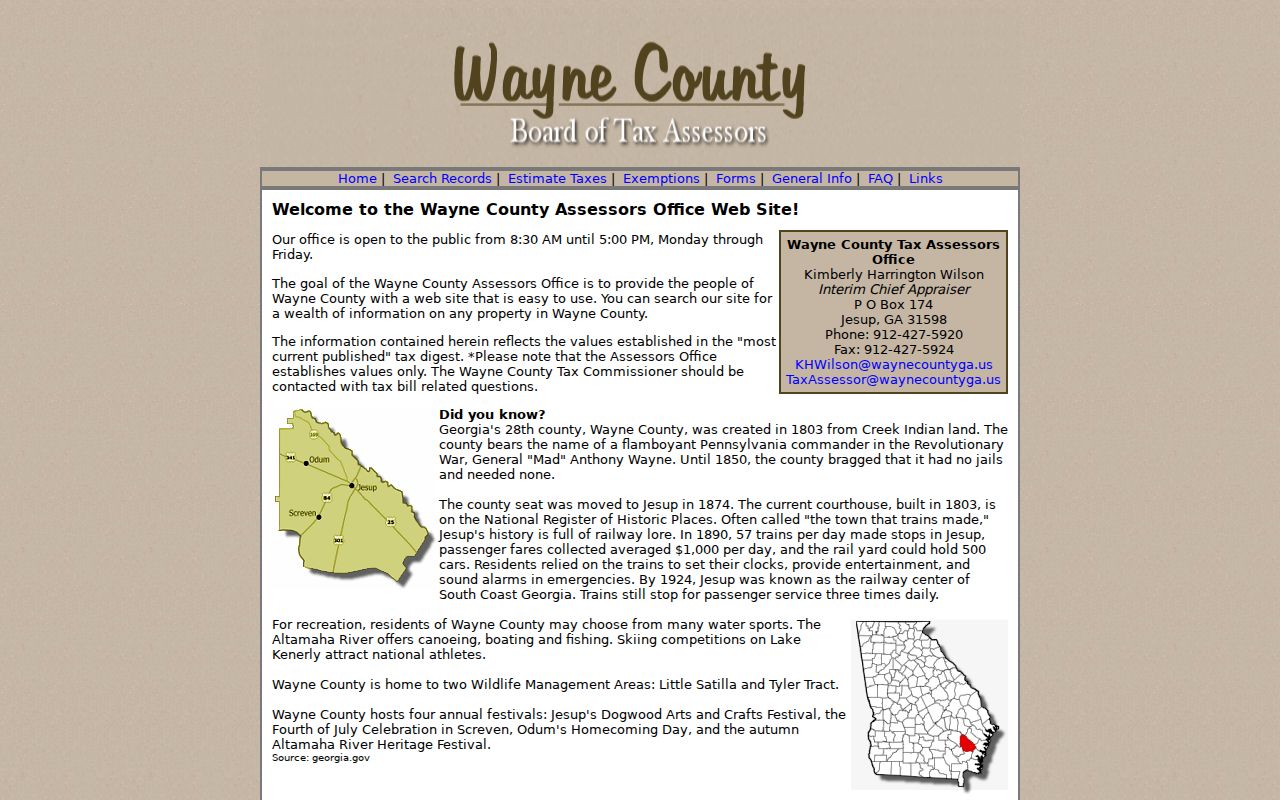
The landing page opens directly onto the live parcel search, so owner fields can be pulled straight from the official site rather than secondhand.
Trace Wayne County Ownership Sources
No single screen answers every ownership question. The assessor roll is quick. The deed is stronger. The remaining sources resolve recent or entity-held transfers. When names differ, compare dates and legal descriptions before concluding that two property records truly conflict.
| Source | Owner Info It Gives | Access |
|---|---|---|
| Wayne qPublic | Owner field, mailing address, physical address, parcel key | Public assessor route; current published digest |
| GSCCCA deed index | Grantor, grantee, instrument type, date, county, book/page | Account terms can affect image access |
| PT-61 search | Buyer or seller, county, dates, and transfer consideration | Statewide transfer search; not a deed substitute |
| Georgia eCorp | Business identity, status, agent, officers, and filings | Public entity context; does not decide title |
The occupant may have no tie to the owner of record on the tax roll. An owner can list a different mailing address entirely. An entity can hold title with no person named as grantee. Use public property records for lawful land research. Use them for purchase diligence, an estate question, or another valid property purpose.
Trace the Wayne County Deed
The Wayne County Clerk's real-estate search page routes deed research to the statewide GSCCCA Real Estate Index. It also offers a historical image route. Search the qPublic owner as a grantee first. Then compare the newest deed's property location and legal description against the parcel card. Check the book and page and any prior reference there too.
The state index runs from January 1, 1987 through August 31, 2026. Treat that good-through row as a moving window rather than a promise. A deed can be recorded before its index entry reaches the statewide screen. So note the live date on the Clerk's page. The Clerk remains the custodian of deeds and related instruments for Wayne County.
Resolve Wayne County Transfer Lag
A new deed, qPublic card, tax bill, and assessment notice can show different stages of one transfer. Wayne Board of Assessors material from 2025 says the person and address on the most recent PT-61 continue to receive assessment mailings and discusses added-owner notices and parcel splits. Tax bills are generally tied to ownership as of January 1. Neither point makes the tax roll a live title register.
When a sale is recent, use the GSCCCA PT-61 buyer or seller search as a bridge, then verify the deed image. Search dates and county help narrow common names. PT-61 consideration can explain a transfer, but the filed deed remains the core ownership document.
Note: A deed may reach the Clerk's record before the assessor refreshes the owner field in the published digest.
Identify Wayne County Entity Owners
When qPublic lists a company, copy the name exactly. Put it into the Georgia Corporations Division eCorp search. The state tool accepts a business name, control number, registered-agent name, or officer name. Its filings and status can separate similar names. They can also hint at who may sign for the entity.
An entity record never replaces the deed. It does not prove an officer owns the land personally. Trusts and estates deserve the same care. Keep labels such as trustee, executor, administrator, or estate attached to the person's name. Turn to probate or court material only when the transfer requires it.
- Owner of record
- The name carried on an official roll or recorded instrument at a stated time.
- Grantee
- The party receiving the interest stated in a deed.
- Title
- The legal rights in land, which a tax card or one index hit cannot fully prove.
- Situs address
- The property's physical location, distinct from the owner's mailing address.
Respect Protected Wayne County Addresses
Georgia property records are public, with exemptions and redactions built in. Safe at Home can substitute a designated public address for eligible survivors. It also forwards mail for other qualifying people. A record carrying such an address must stay protected. Do not try to reconstruct the confidential location from unrelated sources.
The Georgia Safe at Home program is the official source for eligibility and contact. Wayne County publishes no broad opt-out from property records. Any request to shield a particular field must rest on the law that covers it.
Reach Wayne County Record Custodians
A stalled portal search is not a dead end. The Wayne County Tax Assessor can match an address to a parcel key, legal description, or prior parcel reference when the online tools fall short. For deeds, plats, liens, and permanent land records, the Wayne County Clerk's Real Estate Division is the custodian. Visit the counter at 174 N Brunswick Street in Jesup, call 912-427-5930, or stop by on weekdays between 8:30 a.m. and 5:00 p.m. Written requests work best under Georgia's Open Records Act. Name the record and the custodian. Attorney General guidance generally expects a response or delay notice within three business days, and direct search, retrieval, and copy costs may apply. Older deeds may sit on microfilm. Deed books, microfilm, and collection-specific Georgia Archives resources also support older land research.
Test Wayne County owner names. A sound match can hide behind a spelling variation. The GSCCCA name form allows searching all parties, grantors only, or grantees only, with filters for instrument, county, neighboring counties, and date. Start with the exact qPublic wording. Then test a middle initial, a prior surname, a business suffix, or the reversed name order used in the recorded index. Very short names may need added filters. One matching name is never enough. Compare the legal description, property location, deed date, and book/page against the parcel in question. Companies are trickier, since an eCorp control number and formation record can separate entities with nearly identical names. For trusts, keep the trustee's capacity attached. Estate files can be confusing too, because an executor or administrator may sign while the deceased owner still shows in an older source. Sometimes a party recorded related land in another county. A statewide or neighboring-county search can catch those instruments, though it also multiplies false matches. Wayne County and the legal description stay central. That discipline identifies a property owner without turning the search into a broad profile of the person.
Rank Wayne County ownership evidence. Ownership evidence forms a ladder. The map locates the tax parcel. A parcel card names the owner on the assessment roll, while PT-61 data flags a recent transfer. The deed names the parties and land. Court, probate, lien, and plat records explain the exceptions. A firm legal conclusion may still call for certified records and qualified title review.
Keep a short research log. Record the portal, search date, exact name, parcel key, instrument type, and book/page each time. Wayne's online good-through date changes, and the qPublic digest can refresh later than a deed. A dated log exposes those gaps. It also keeps a later search from treating an old screenshot as a current answer.
Identify Rural Wayne County Owners
Rural Wayne County land does not always key to an address. Deeds and county forms lean on land lot, district, acres, map/parcel, road, creek, seller, and deed book/page details. Parcel codes also vary, mixing letters, numbers, and hyphens. Copy the full parcel key without decoding it. A truncated key may return nothing at all, or worse, the wrong tract.
qPublic sometimes rejects the road address. Search the known owner or legal information instead. The Assessor can match older and current parcel references after a split or combination. Then carry the legal description to the Clerk's index. This route works even when a rural mailing address changed or never appeared in the old deed. Transcribe metes-and-bounds calls as written. A call naming a creek, road, monument, or adjoining owner is a retrieval clue, not a boundary claim. Exact lines need the latest survey and controlling instruments.
Test the Wayne property owner answer. Three questions close out a search. Does the parcel card describe the right land? Does the newest deed name that land and the current grantee? Has a later transfer, estate deed, foreclosure deed, tax-sale deed, trustee's deed, or court order intervened? The answer is only as current as the last source checked. A security deed, lien, assignment, release, or cancellation can affect the property without changing the owner. Track those records separately. The current tax card may also omit easements, covenants, leases, mineral interests, and other rights recorded in instruments or plats.
A confirmed owner mailing address serves a simple contact need. A purchase, dispute, or legal claim calls for inspected images and certified records where appropriate. A professional title search resolves what portals only flag. That final check identifies the property owner as of the latest reliable source. It also keeps ownership distinct from occupancy or use.
Limits of a Wayne County Owner Lookup
A Wayne County owner lookup has clear limits. An index can hand you a tax-roll name and a recorded grantee. But that is where certainty ends. It cannot tell you who actually occupies the site. Nor can it surface every co-owner, beneficial interest, or later deed recorded after the entry you pulled. Boundary questions, liens, estates, court orders, and easements all sit outside what a parcel search resolves. Index labels are finding aids, nothing more. Their classification never decides an instrument's legal effect.
Before a purchase or any disputed interest, inspect the recorded instruments themselves. Bring in qualified title help. And never use an owner of record name to stalk, harass, or defeat a protected address. The weightier the legal or financial decision, the less it should rest on one public screen.
Ownership is not occupancy. A Wayne County owner name is a property-research lead, not permission to target or disturb any person.