
Check Wayne County's Owner Record
The Wayne County qPublic parcel card serves as the working current-owner record. Its labels cover Parcel ID, Owner, Owner address, Physical Address, class, taxing district, acres, assessed value, and a sales table. Treat the card as a dated assessment record. It reports what the published tax digest carries now, not a live ruling on title.
| Owner | Name carried on the published parcel record |
|---|---|
| Owner address | Mail destination for the owner or notice recipient |
| Physical Address | Situs of the parcel, which may differ from the mailing address |
| Parcel ID | County key connecting the card and map |
| Sales table | Date, price, reason, and qualification in the documented layout |
| Deed reference | Lead for finding the latest recorded instrument when present |
Keep two ideas apart: the named owner and the occupant. A mailing address can sit far from the property. A business may hold the parcel. Use the roll to check who owns now. When accuracy matters, verify the newest deed before acting on the parcel card alone. See the official assessor entrance pictured below.
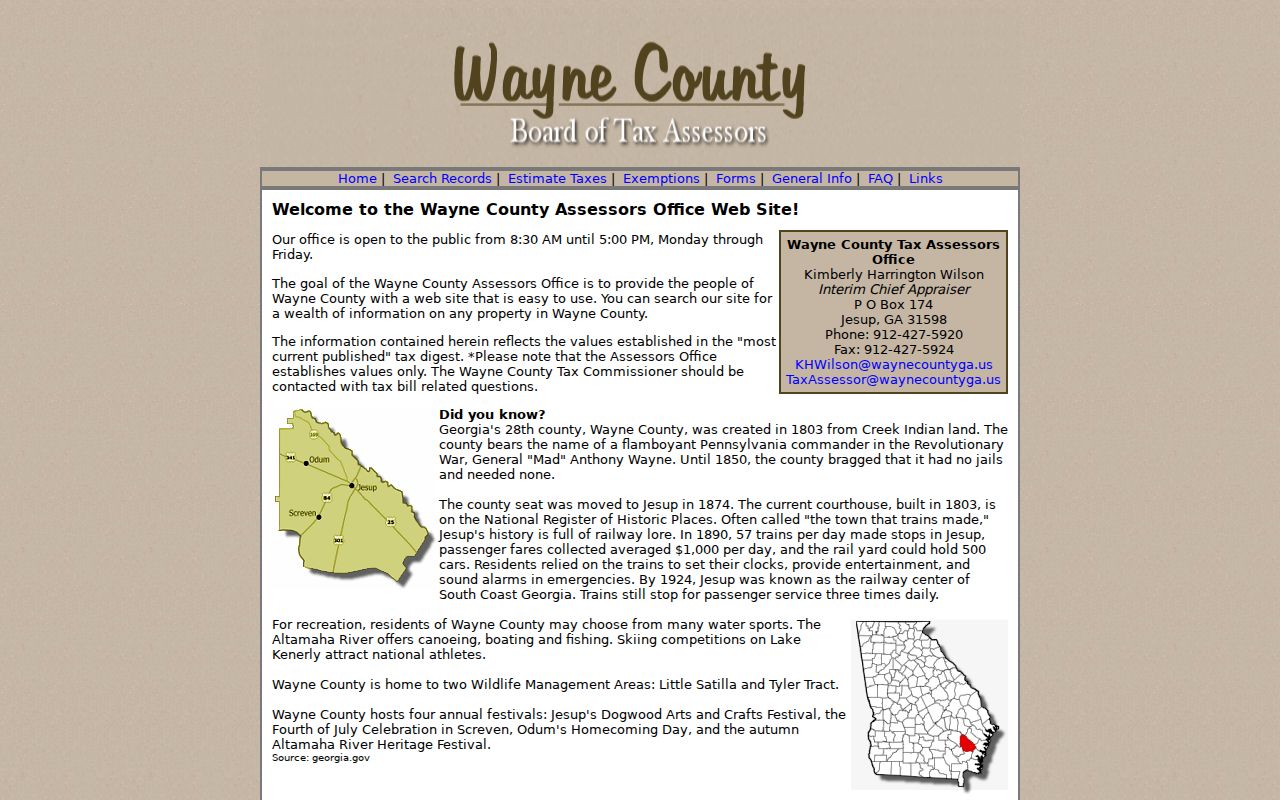
The official county page shown here marks the source, while the live parcel card supplies the current owner fields.
Gauge Wayne County Record Freshness
qPublic states that its public data mirrors the most current published tax digest. Wayne County publishes no roll-refresh calendar. A deed can therefore be recorded before the parcel card catches up. The Tax Commissioner's bill follows January 1 ownership rules too. So a bill name is not a same-day test of who holds title.
One September 2025 Board of Assessors item adds a wrinkle. The person and address on the most recent PT-61 keep receiving assessment mailings. The board also discussed extra-owner notices and parcel splits. That mailing workflow explains why current owner records can drift apart. It does not prove which source controls title.
Check the date. The assessment roll can lag a recent sale; the newest recorded deed is the fresher ownership evidence.
Verify Wayne County's Current Owner
To confirm ownership, match the assessor's present name against the latest instrument filed with the Wayne County Clerk of Superior Court. This is a narrow check. It is not a full backward chain of title. Match the property itself first, since an identical name does not guarantee the same parcel.
- Read and copy the qPublic Owner, Parcel ID, Physical Address, and any newest sale or deed reference.
- Use the GSCCCA Real Estate Index to search the listed name as grantee in Wayne County.
- Open the newest plausible deed and compare its legal description, execution date, recording date, and book/page with the parcel.
- For an entity, verify the exact company name and status in Georgia eCorp. Preserve trust or estate capacity in the owner wording.
- Owner of record
- The party named on a given official roll or instrument.
- Assessment roll
- The county's published parcel and value record for tax administration.
- Situs
- The physical location of land, separate from the owner's mailing address.
- Recording lag
- The interval between a filed transfer and its appearance in another public system.
Separate Wayne Mailing and Situs
One Wayne qPublic sample makes the distinction plain. It listed a Physical Address of 597 NEBRASKA RD against an Owner address of 4013 EAGLE DR, JESUP, GA 31546. Those fields answer different questions. One locates the parcel. The other routes owner mail. Neither shows where a person sleeps or whether someone else occupies the site.
For lawful contact, use the published owner mailing address exactly as written. Do not assume the mailing address is another owned parcel, and do not try to defeat a substituted or protected address by joining unrelated records.
Confirm Wayne County Business Owners
An LLC or corporation on the parcel card calls for one more step. Search the exact business name through Georgia eCorp. The official search accepts a business name, control number, registered-agent name, or officer name. It returns status and filed entity records. That helps separate similar business names.
A registered agent is the person or service named to receive formal process for an entity. Agent status does not make that person the parcel owner. The recorded grantee remains the real title lead.
Check Wayne County Title Changes
A warranty deed is not the only instrument that changes the owner of record. The Wayne Clerk's inventory spans quitclaims, gift deeds, and executor's and administrator's deeds. It also includes foreclosure deeds, tax-sale deeds, court orders, trustee's deeds, and title-registry transfers. Each one must be read in its own legal setting.
Liens, security deeds, assignments, and releases affect the parcel without always transferring ownership. Compare the grantee clause and the legal description. Do not treat every recent recording as a new owner. When probate, a court, or an estate sits behind a transfer, the related case file may explain the authority driving the deed.
Reach Wayne County Owner Custodians
A blocked or confusing online card is not a dead end. Call the Wayne County Tax Assessor at 912-427-5920 during public hours, 8:30 a.m. to 5:00 p.m. on weekdays. The Clerk's Real Estate Division sits at 174 N Brunswick Street, Jesup, Georgia 31546, and answers at 912-427-5930 on the same posted weekday schedule.
Any citizen may request copies of the permanent property records, according to the Clerk. When a county record is not exposed online, a written request under the Georgia Open Records Act works: identify the parcel, the relevant date, and the custodian. A response or delay notice is generally due within three business days. Direct retrieval and copy costs may apply.
Note: Before discussing cost, ask whether the item is a plain copy, certified copy, recorded image, or assessor record.
Compare Wayne County sale dates.
The documented qPublic layout offers a sales table with date, price, reason, and qualification. Test the owner record against its newest row rather than replacing the deed. A sale price can differ from assessed value. A family, estate, or other transfer may carry terms no short table can explain. PT-61 adds buyer, seller, county, dates, and consideration.
Line up execution, recording, assessment, and notice dates. A deed signed first may be recorded later, then indexed, and finally reflected in the tax digest. The present owner question turns on the newest controlling transfer, while the tax system runs on its own roll and billing cycle. If names still conflict once the dates align, ask the Clerk for the newest recorded image.
Protect Wayne County Owner Addresses
Public access has limits in Georgia. Open records guidance allows some personal and financial data to be redacted. Safe at Home substitutes a public address and forwards first-class mail for eligible survivors and others at risk. Use the designated address as published.
Wayne County offers no blanket opt-out from all property records, so protection depends on a statute or program covering the field or person. Ask the record custodian about a specific protected item. Turn to the official Safe at Home program when its eligibility rules may apply. Never combine other records to expose a confidential address.
Address protection does not erase the deed. It changes what contact data is shown and how mail is routed. Keep the property question narrow. Accept a lawful redaction and send correction requests to the office that publishes the field. The assessor controls its parcel display, the Clerk controls recorded instruments, and the Secretary of State administers Safe at Home.
Match Wayne County owner records.
A current owner name means little until the parcel is matched. Copy the complete Parcel ID, Physical Address, acres, class, taxing district, and deed or sale reference from qPublic. Wayne County identifiers follow no single fixed pattern. Keep every letter and hyphen intact. A rural parcel may also need its land lot, district, road, creek, or acreage to separate it from neighboring land.
Then compare the recorded legal description. A platted lot should match its subdivision, lot, block, phase, and plat citation, while a metes and bounds tract should match its stated district, land lot, monuments, roads, creeks, and adjoining owners. Splits and combinations cause the most confusion. Did today's parcel come from either one? Ask the Assessor for the old parcel link and the Clerk for the deed or plat that created the change.
This step guards against a same-name error. A mailing address is not the parcel. The current owner record should point to the land under review, not merely to a familiar person or company.
Read Wayne County's Newest Deed
Read the newest recorded deed itself. Never settle for the label in the index. The grantor and grantee names, the legal description, and the book/page or instrument number tell you who conveyed what to whom. Look at execution and recording details, the notary block, and any attached exhibits too. A quitclaim, gift deed, or correction can change ownership in ways a routine sale does not. Executor's, administrator's, trustee's, foreclosure, and court-order deeds each carry their own effect.
The Wayne Clerk follows statewide indexing standards. An instrument may appear under more than one type. Classification alone never decides legal nature. If a first pass is unclear, search the owner name in both party roles. Compare your latest result with the index's live good-through date. That keeps transmission lag from being mistaken for no filing.
Security deeds belong to the debt trail. So do later assignments and cancellations. They matter for title research. Still, a lender named on the parcel is not the current owner. The grantee and the granting text stay central.
Choose Wayne County owner proof.
Different tasks call for different proof. A qPublic card may suffice for a routine land-related letter. A recent deed image works better for confirming who owns now. A certified copy can support a formal file. For a purchase, disputed boundary, estate, or contested interest, a full title examination beats any single online search.
Keep the search date and source with each result. Wayne's qPublic data reflects the published digest. The tax bill follows January 1 ownership rules. PT-61 connects transfer parties and consideration. GSCCCA carries its own live good-through date. Those clocks explain many apparent conflicts. They also show why the current owner of record must be stated as of a source date.
An unresolved court, probate, foreclosure, or tax-sale matter needs follow-up. Take it through the Wayne Clerk or Probate Court. Do not guess from the parcel card. The assessor identifies a roll owner. It does not adjudicate legal title.
Contact a Wayne County Property Owner
The parcel card's owner mailing address is the official contact lead. It serves a valid property matter. Write clearly and state your reason for contact. Identify the land precisely. A public name grants no right to visit, monitor, pressure, or disturb anyone.
Georgia Safe at Home can substitute a designated public address for eligible at-risk people. Respect it. The program forwards qualifying mail while shielding the confidential location. A current owner lookup serves lawful deed, boundary, estate, sale, and civic research.
Lawful use. Use Wayne County owner records for a valid property need. Never use them to stalk, harass, intimidate, or harm anyone.