
Trace Wayne County Former Owners
Build the chain in reverse. Every deed names a grantor. The grantor gave up the stated interest. The grantee took it. The legal description and any prior book and page reference keep the search locked onto the same land. Names, parcel numbers, or street addresses shift over the years. Match those anchors at each step before moving back another generation in the Wayne County deed records.
| Record stage | Grantor to grantee | Instrument clue | Reference to capture |
|---|---|---|---|
| Newest transfer | Immediate former owner to present grantee | Read the filed deed type | Current book and page |
| Prior transfer | Earlier owner to that former owner | Match index and image | Prior deed citation |
| Older transfer | Previous grantor to prior grantee | Note estate or court authority | Older index entry |
One row's grantee becomes the grantor you search for in the next row back. Test every link against the land description itself. A shared name, a business rename, a trustee swap, or a family transfer can silently splice two unrelated chains together if you skip that check.
Go Back Through Wayne GSCCCA
The GSCCCA Real Estate Index filters by grantor, grantee, instrument, county, neighboring county, and date. Its Wayne coverage row runs from January 1, 1987 through August 31, 2026. System pages can show a different snapshot, so confirm the live good-through date before you rely on the range. Check the Wayne good-through page directly. Search the newest deed's grantor as a grantee. A common surname needs narrowing by Wayne County, date, and instrument type, then a comparison of book, page, and legal description. Try alternate spellings and exact business names. Index wording drifts across decades of deed records.
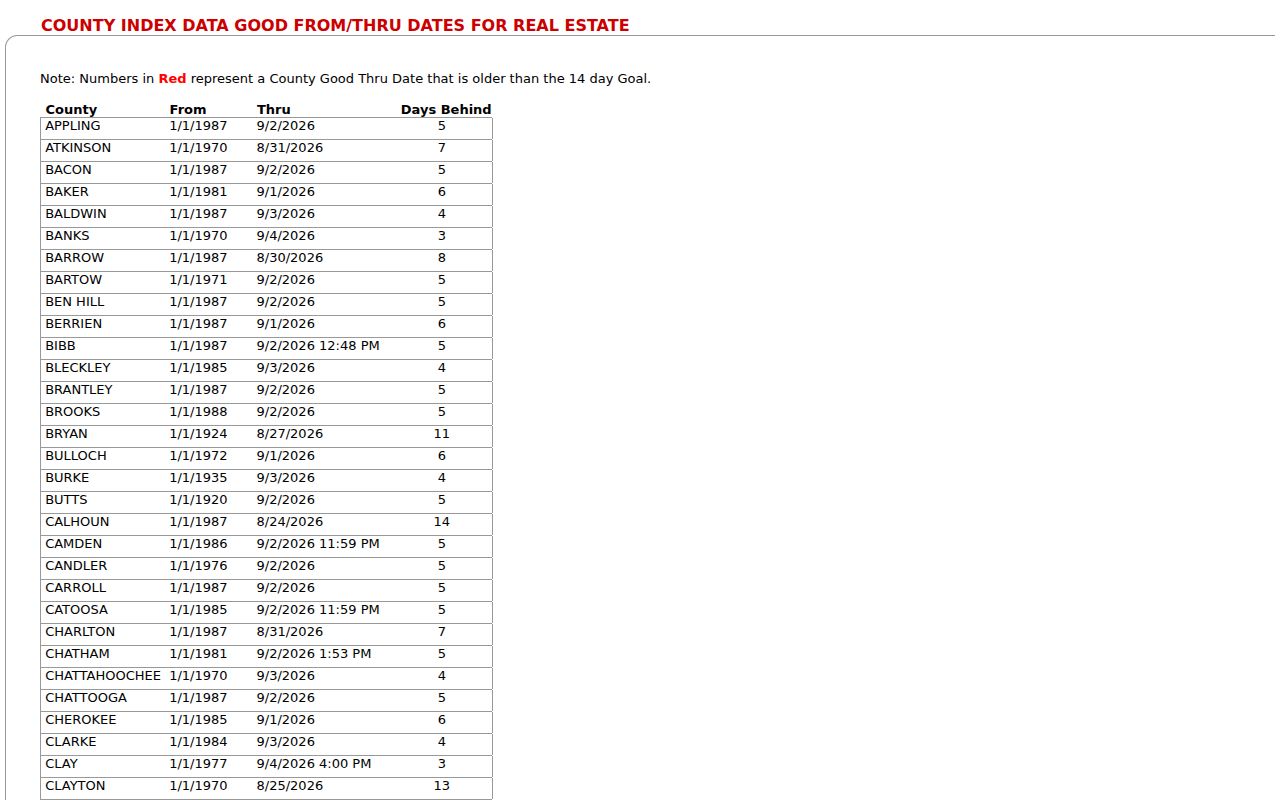
Note: The good-through table shows where the online index starts, not the first year Wayne County kept deeds.
Reconstruct Wayne County Ownership Backward
A chain is an evidence trail, not a name list. Read each deed image and record its reference. Confirm the conveyed land actually matches. Index labels help you locate instruments, but they never decide an instrument's legal character in the Wayne County property records.
- Start with the latest deed reference from the parcel card, deed index, or current recorded image.
- Read the grantor, grantee, dates, legal description, and prior book/page reference.
- Search that grantor as a grantee to find how the former owner acquired the property.
- Repeat to the target date or online cutoff, checking plats, estate files, and court deeds when the chain changes form.
- Grantor
- The party who conveyed the interest stated in an instrument.
- Grantee
- The party who received that stated interest.
- Chain of title
- The linked sequence of recorded transfers affecting the same land.
- Reverse index
- An index arranged by grantee, useful for finding how a later grantor acquired land.
- Quitclaim and warranty deeds
- Different deed forms whose actual terms must be read.
Follow Wayne Deed Book References
A book and page citation bridges generations of Wayne County deeds cleanly. The GSCCCA book and page search asks for the county, a book of up to five characters, and a page of up to four. Keep the letters and formatting exactly as the source shows them. Exhibits and continuation pages matter too. Easements, reservations, prior calls, and the full legal description often sit past the first image. An older deed may cite a plat. It may also cite an even earlier instrument. That opens a path no name search could find.
Reach Pre-1987 Wayne County Owners
The online index begins in 1987. Earlier Wayne County prior owners live in courthouse deed books, tax digests, and plats. Probate or Ordinary files and related Superior Court material also hold them. The Clerk's Property Division holds these records permanently, and any citizen may obtain copies. Ask the Clerk for older grantor and grantee indexes, deed book images, or microfilm. The Georgia Archives Virtual Vault carries selected deed and tax collections. The DCA property guide points old deeds to the Clerk or Archives. It points estate records to Probate or archival microfilm. Scattered online hits do not add up to a complete Wayne County run.
Online cutoff. Wayne's observed GSCCCA index starts in 1987. Trace older owners through Clerk indexes, deed books, microfilm, and archives.
Match Rural Wayne County Descriptions
Rural land often outlives its street address. Wayne deed records lean on land lot, district, acreage, roads, creeks, adjoining owners, survey data, and metes-and-bounds calls. Parcel identifiers vary too. Official examples mix letters, digits, and hyphens. So treat the full code as one county key. When a tract was split or combined, ask the Assessor for historic parcel references. Ask the Clerk for the deed or plat that made the change. A previous owner may tie to a larger parent tract rather than today's parcel number. Compare only the portion conveyed.
Bridge Breaks in Wayne Ownership
Not every transfer is a simple sale. A chain can pass through an estate, foreclosure, tax sale, sheriff's deed, trustee's deed, court order, or business entity. That breaks the seller-to-buyer pattern. Search both party directions. Read the authority named in the deed, and check probate or civil material when the trail demands it. Security deeds, assignments, releases, and liens touch the land without changing its owner of record. Track them on a separate encumbrance trail. That discipline keeps a lender or lienholder from being mislabeled a former owner on the tax roll.
Use Wayne Plats as Timeposts
A recorded subdivision plat freezes the lot, block, road, common area, and easement scheme. It captures all of that at one moment in time. When a deed names a subdivision, search the Wayne Clerk's plat route. Statewide county submissions began under the uniform program in 2004. The Clerk reports plats e-filed across Georgia since 2017. Wayne tax-sale notices supply local leads. They name subdivisions like Pepper Hill, Seminole Woods Phase 9, Riveroaks, Dreamland, and North Garbutt with book and page clues. Treat those dated notices as leads only. Each recorded deed and plat still settles the question in the Wayne County property records.
Access Wayne County Deed Books
The Wayne County Clerk of Superior Court keeps the deed books. Its Real Estate Division sits at 174 N Brunswick Street in Jesup, Georgia 31546, and answers the phone at 912-427-5930 on weekdays from 8:30 a.m. to 5:00 p.m. The Clerk's deed-search page points researchers toward GSCCCA and a Wayne historical image viewer. Even so, the physical office remains the best fallback. That is where the bound volumes live.
Come prepared. Bring current and former owner names, rough transfer years, book and page clues, the parcel key, and a short piece of the legal description. Request the direct and reverse indexes for the years in question. If a volume is not online, staff can say whether it survives as a deed book, sits on microfilm, or lives in another historical image system. Citizens may order copies, though the office should confirm current copy and certification charges.
A written Open Records request offers a second channel for a specific county record. Georgia guidance asks that the requester identify the records and the custodian. A response or a delay notice is generally due within three business days. Broad title research does not fit that mold. Narrow any request by names, dates, and record references.
Log Wayne County previous owners. Record each link as it turns up: grantor, grantee, deed type, execution date, recording date, book and page or instrument number, the legal-description match, and any prior reference. Note whether the evidence came from an index label, a full image, a certified copy, a plat, or a related court or probate file. This discipline keeps a likely name from hardening into an unsupported owner claim.
Log the misses too. Failed searches and spelling variants belong in the record. A missing online hit before 1987 may reflect coverage gaps rather than a lost deed. A later parcel split can point back to a parent tract. Trusts, estates, and businesses can scramble the name pattern entirely. The log makes each problem visible and shows where the backward chain still needs another source.
When two deeds seem to skip a former owner, test the dates and roles before filling the gap. One party may have signed as trustee, executor, attorney-in-fact, or company officer. A corrective deed can repeat a transfer without creating a new period of ownership. A boundary deed or quitclaim may touch only part of the land. Read the granting clause and the legal description before adding any name to the timeline.
End the search where the evidence ends. If a volume, index, or image cannot be found, write down that gap and the office contacted. An honest break in the Wayne County chain beats a guessed previous owner. Former owners earn a place on the timeline only after the deed and the land both match. Tax or archive sources can support the trail. Recorded deeds remain its main links.
Measure Wayne County Record Depth
Wayne County dates to 1803. The earliest surviving records, though, tell a murkier story. The Clerk publishes no confirmed first deed book, no full microfilm inventory, and no courthouse-loss chronology. So skip the neat endpoint. Work backward instead from a known later deed through the Clerk's indexes, then ask which physical or filmed volume covers the next date and name.
The county seat moved to Jesup in 1874. Pre-digital holdings include deeds, tax digests, plats, probate files, and court records. Old place names, roads, rail references, and adjoining owners can help retrieval. The legal description must still carry the match.
Use the record lawfully. Trace former owners for title, estate, or property history, never to track, target, or harass a living person.